smalltalk
30 August 2010 10:39:25 AM
There have been some pretty major changes to the way memory is handled in VisualWorks in the 7.7.1 release - and that means that there have been changes for ObjectStudio 8.2.1 as well, since it's built on top of VisualWorks. You should really have a look at the release notes for 7.7.1, and the class comments for AbstractMemoryPolicy. This visual of the new hierarchy makes it clear what's changed:
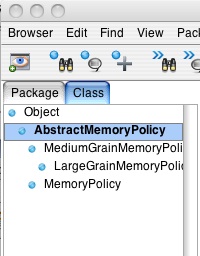
Class MemoryPolicy is mostly a "legacy" class now, and is not the default one in use. The default is LargeGrainMemoryPolicy, as internal testing in Cincom engineering indicated that it performed best in the widest variety of situations.
Your mileage may vary, of course - so again, have a look at the docs.
Technorati Tags:
visualworks, objectstudio, memory policy
posted by James Robertson
smalltalk
30 August 2010 7:07:35 AM
posted by James Robertson
smalltalk
29 August 2010 4:33:53 PM
posted by James Robertson
smalltalk
29 August 2010 3:24:05 PM
Looks like Build tools for Smalltalk are finally starting to catch up. The Squeak/Pharo world has Gofer, the engineering team at Cincom has just released a project tool as part of the summer release (with more work in that direction to come), and Ernest Micklei pushed out a build tool for VA Smalltalk earlier this summer:
Melissa is a simple tool that can help in building development and runtime images in a continous integration environment. It is being used extensively to create daily builds for Smalltalk images. This post describes the steps to use Melissa for VA Smalltalk 8+
A lot of people yawn at these kinds of tools, but they are essential in order to reliably build applications. It's good to see activity here.
Technorati Tags:
build tools
posted by James Robertson
smalltalk
29 August 2010 11:39:03 AM
The deadline for submitting a paper/talk for Smalltalks 2010 has been extended to September 25th. The conference takes place in Buenos Aires (Argentina) November 11-13.
If you're submitting a paper, they want you to use EasyChair.
Technorati Tags:
smalltalks 2010, fast, argentina
posted by James Robertson
smalltalk
29 August 2010 8:26:00 AM
posted by James Robertson
smalltalk
28 August 2010 9:49:46 AM
This is pretty cool - Chris Cunnington (the guy behind Smalltalk TV) has pulled the MPEG player out of Sophie and made it a standalone Squeak project.
Technorati Tags:
squeak, mpeg
posted by James Robertson
smalltalk
28 August 2010 7:41:25 AM
I noticed that Smalltalk fell out of the top 50 in the Tiobe rankings; I think it's not just the niche status of Smalltalk at work here, but also the nature of Smalltalk code. What do I mean by that?
Well, consider what happens when you search for the more mainstream (file based) languages - you get code listings. When you search for Smalltalk, on the other hand, you'll get links to things like the "One Click Image" for Seaside. The image based nature of Smalltalk, and the fact that Smalltalk developers don't work in flat text files, impacts your ability to find Smalltalk code references.
Before the rise of search engines this was not terribly relevant, but now - it makes the community look much, much smaller than it really is. I don't have an answer to this problem - the Smalltalk image is unlikely to disappear (and personally, I'm a fan of it). It's just something we have to factor into these kinds of discussions.
Technorati Tags:
tiobe, image based, file based
posted by James Robertson
smalltalk
27 August 2010 1:03:32 PM
posted by James Robertson
smalltalk
26 August 2010 8:26:00 AM
Pat Maddox is talking up Seaside at Ruby|Web:
Okay as for what's so interesting to me about Seaside... it's 50% the framework and 50% the Pharo environment. Seaside itself represents a step forward in web development similar to how Rails did. Rails takes care of a lot of the plumbing for you - you don't have to parse query params, set up response headers, manage the session (unless you want to of course). Seaside does all that of course but also manages application state for you. So you don't have to worry about putting stuff into a database, then pulling it back out and operating on it. I can't do it justice in a few sentences, but that's why I'll be showing lots of examples at the conference! :) At any rate, that same feeling you get when you code Rails for the first time and see how much easier things are, you get that same feeling with Seaside.
The other thing to keep in mind is that Seaside works across all the Smalltalk dialects - so you can move your application to another Smalltalk if you want/need to - for instance, you might want to consider Cincom Smalltalk if you want full commercial support :)
Technorati Tags:
seaside, ruby
posted by James Robertson