smalltalk
29 October 2010 1:28:09 PM
Looking to learn Smalltalk in a professional setting, but don't have enough people to justify getting an instructor sent to you? David Buck has a solution to that problem: an Introduction to Smalltalk with VisualWorks delivered directly to your browser, from November 29 to December 3:
Attendees will be able to read and write Smalltalk code and will be able to use the Smalltalk environment to continue to enhance their knowledge. Attendees will be able to lay out windows and write the Smalltalk code needed to manage the windows.
You can register at the link - the cost is $1250 per person.
Technorati Tags:
instruction
posted by James Robertson
smalltalk
29 October 2010 9:09:31 AM
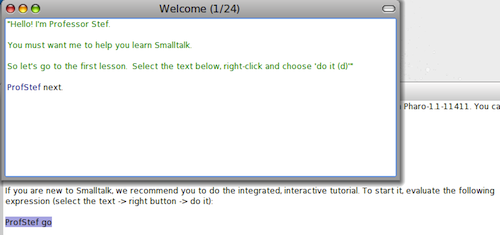
Some of the tools out there make life a lot easier for beginners than they used to be. For instance, in Pharo, there's "ProfStef":
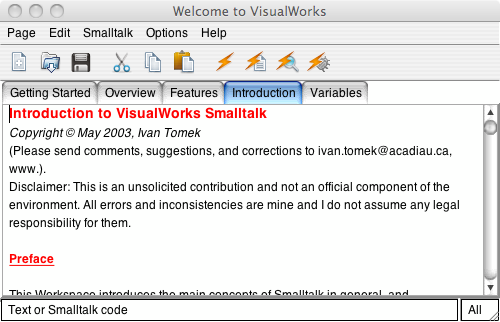
Meanwhile, there's a tutorial in the NC workspace for VisualWorks:
There's also This screencast series, the excellent Smalltalk TV, and the equally excellent Pharocasts. So if you're interested in Smalltalk, just dive right in!
Technorati Tags:
education, screencasts, tutorials
posted by James Robertson
smalltalk
28 October 2010 12:25:04 PM
posted by James Robertson
smalltalk
28 October 2010 6:06:04 AM
Georg Heeg announced an update to SeaBreeze, their GUI builder front end to Seaside:
Currently we are developing a new interesting feature for seaBreeze: Internationalization and Localization. Today we had the great break-through: The first multi-lingual seaBreeze application was up and running on my machine today. We are working together with a master course in software localization at Anhalt University. So please be patient to see progress in the not too far future.
If you're interested in becoming a beta user, follow the link for details.
Technorati Tags:
seaside, seabreeze
posted by James Robertson
smalltalk
26 October 2010 6:48:59 PM
The FAST Foundation is offering help for Argentinians who would like to attend the Smalltalks conference next month, but need some help:
This year, the Fundacion Argentina de Smalltalk (FAST) will be able to offer some degree of assistance to attend the conference. In order to qualify for this support, it is necessary to live in Argentina, to reasonably justify the need for assistance, and to have submitted a talk proposal to the conference.
Technorati Tags:
smalltalks 2010, argentina
posted by James Robertson
smalltalk
25 October 2010 9:08:27 AM
posted by James Robertson
smalltalk
24 October 2010 5:36:52 PM
posted by James Robertson
smalltalk
24 October 2010 9:42:57 AM
Ramon Leon explains how to run Gemstone tools from a remote server with better performance: X11
Just a quick post to document some knowledge for myself and for anyone using Gemstone on a remote server like SliceHost or my preference Linode and trying to run GemTools locally through a ssh tunnel. It's slow, very slow, several seconds per mouse click. OmniBrowser is just to chatty. Fortunately Linux has a better way to do it: X11Forwarding. Run the GemTools client on the remote server and forward the UI for just that app to your workstation.
Follow the link for full details.
Technorati Tags:
gemstone, x11
posted by James Robertson
smalltalk
24 October 2010 7:43:01 AM
There's a new framework in Cincom's Smalltalk that allows you to take advantage of multiple CPUs or cores - polycephaly. There's an interesting write up over on the CST website, which comes from the ObjectStudio team:
Polycephaly allows the user to spawn new copies of your ObjectStudio VM and image. Since Windows sees these new copies as separate programs, it can schedule them on any available CPU. One use of Polycephaly could be to connect to different web services at the same time and read some data. We currently use Polycephaly to run our SUnit test suite.
Follow the link for some code you can experiment with.
Technorati Tags:
polycephaly
posted by James Robertson
smalltalk
23 October 2010 7:01:13 AM
It looks like Xtreams is getting attention beyond the world of Smalltalk implementations. Derek Williams writes:
Smalltalk is home to perhaps the first truly elegant streams implementation, particularly when compared to other approaches developed around that time, such as those in C and C++. You can’t get much simpler than ‘myfile.txt’ asFilename readStream contents to open and read a file, and yet there’s significant power in the classes behind that. But new designs for stream libraries since followed, including pluggable/chainable I/O stream architectures, such as those found in Java, C#, and even advanced parallel stream processing frameworks. Not to be outdone, Michael Lucas-Smith and Martin Kobetic have recently developed a new pluggable stream framework for Smalltalk called Xtreams, and I couldn’t resist giving it a try.
There's a lot more there; follow the link.
Technorati Tags:
xtreams, streams
posted by James Robertson